
Dear Shepherdstown Community Stakeholders,
For almost 70 years, Shepherdstown Elementary School stood as a cornerstone of our town, nestled on the outskirts of city limits and easily walkable for many families. This proximity fostered a tight-knit social fabric, where generations of children could stroll to school, interact with neighbors, and build lasting community bonds. However, with the recent relocation to a new building approximately one mile south, this dynamic has shifted dramatically. Now, most students will rely on buses or car rides, diminishing the organic interactions that defined our town’s daily life for generations, weakening the communal ties we cherish.
As the old school building faces possible demolition to make way for undetermined development on its 8-acre parcel, we have a unique opportunity to honor the site’s historical role and mitigate the loss to our community. I propose that the Jefferson County Board of Education gift a modest 2-acre sub-parcel in the north of the lot to Starlight Studio, the non-profit organization I founded and direct that is dedicated to educational enrichment in our community. Included in this area is the natural amphitheater affectionately known as Donley Grove and a serene tree-covered space along Town Run featuring the beloved Grotto bridge. Much of it lies within the flood zone, rendering it unsuitable for commercial or residential development and ideal for preservation as a natural haven.
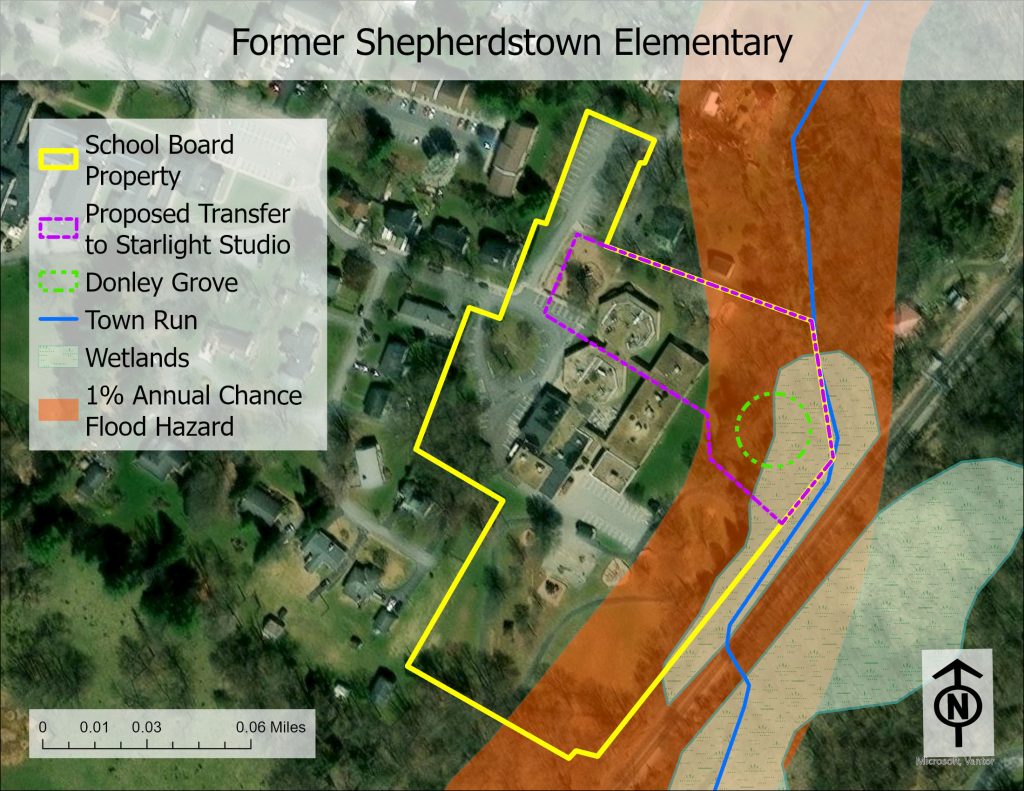
If demolition of the building is pursued, the proposed gift could also include one of the two architecturally unique hexagonal-shaped portions of the school along the north side of the building that held class for generations of Shepherdstown students. Starlight Studio would work to transform this gifted land and portion of the building into a community center focused on educational enrichment activities for the next generations of Shepherdstown’s school-aged children. Programs could include after-school workshops, arts and science explorations, nature-based learning along Town Run, and community events that preserve part of the intergenerational connections lost with the school’s move. By preserving Donley Grove as an adjacent green space, we ensure environmental stewardship while creating a vibrant hub that echoes the original school’s role in nurturing our youth.
This initiative asked for no financial commitment from the Board—only a thoughtful land gift that aligns with their mission to support education and community welfare and coordination with any other parties involved in redeveloping the land. It would preserve and safeguard a piece of Shepherdstown’s heritage, prevent unsuitable development in a flood-prone area, and reinvest in our children’s future.
Join us in building grassroots support! Share this proposal with friends, neighbors, and local groups or if called to do so, contact the Jefferson County Board of Education at info@jcswv.org or 304-725-9741 to voice your endorsement. Visit our donate page to view computer renderings of a vision for this community center space. Together, let’s keep Shepherdstown’s spirit alive.
Sincerely,
Dr. Jeff Groff
Founder and Director, Starlight Studio
Historical Sketch of Shepherdstown Elementary School (Old Building)
(Disclaimer: The following is a preliminary historical sketch in need of citations and vetting.) Shepherdstown Elementary School, originally located at 662 S. Church Street in Shepherdstown, West Virginia, served as a key educational institution in Jefferson County for nearly seven decades. Built in the mid-1950s during a period of post-World War II expansion in the region, the school exemplified efforts to modernize public education facilities.
Initial Construction (1956–1957)
The school opened its doors in 1957, taking over from the historic Shepherdstown Graded School, which had roots in the 19th century. Estimates place its initial size at around 27,000–30,000 square feet, supporting basic K-6 education (with kindergarten introduced county-wide in 1972).
Subsequent Expansions (1969, 1976, 1991)
As enrollment grew and educational standards evolved, the school saw several additions, supported by county bond levies:
- 1969 Addition: Funded through a $3.1 million bond approved in November 1968, which aided multiple schools in Jefferson County.
- 1976 Addition: Backed by a $1.5 million bond passed on February 14, 1974, for district-wide enhancements.
- 1991 Addition: Part of an $18 million bond approved on February 11, 1989, adding spaces for contemporary needs.
These expansions expanded the building to about 40,179–49,155 square feet by the early 2000s. It remains to determine which period of construction resulted in the school’s distinctive hexagonal elements. U.S. school records suggest such geometries were a mid-20th-century design trend that favored such shapes for efficiency, light distribution, and openness.
In the 2020s, the facility encountered challenges such as aging infrastructure, including roofing, windows, and HVAC systems, alongside issues with modern safety compliance. Maintenance costs surpassed 30% of replacement value, leading to its classification as outdated.
Relocation to the New Building (Late 2025)
A $43.7 million bond, approved by Jefferson County voters in November 2020, funded a replacement school (and one in Ranson). Construction started in December 2023 on a 98-acre site near Flowing Springs Road and Gardner Lane, with ZMM Architects designing a 57,445-square-foot modern facility featuring STEAM labs, outdoor learning areas, adaptable spaces for 450–600 students, and the most acoustically-frustrating art room in the universe. The new building was dedicated on December 11, 2025, and students began classes there on January 6, 2026. The original site’s future—potentially for sale or reuse—remains to be determined.
WV Law Governing Transfer of School District Lands and Buildings
When a county school board determines that any building or any land is no longer needed for school purposes, WV Code outlines legal means for the board to transfer these facilities and/or lands to new owners. While WV code section $18-5-7 states that “the county board may sell, dismantle, remove or relocate the building and sell the land on which it is located at public auction”, section $18-5-7B creates the framework for boards to transfer such property to charitable organizations for “community use.”